

Engrit Liaw
Sabah Timber Industry Employees Union (STIEU)
Malaysia, Social South
What inspired a trade unionist to become an FSC member and how does this align with your personal or professional values?
Many of FSC’s principles align with core trade union values such as workers' rights, social justice, and sustainable development. The solidarity and collective action from a multi-stakeholder approach reflect the unionist value of collective decision-making and collaboration across various interests.
In FSC it emphasises social responsibility, including upholding workers' rights and supporting Indigenous communities, similar to a trade unionist's commitment to justice and equality. The audit and certification process promotes transparency and responsibility in supply chains, which resonates with union efforts to hold employers and industries accountable. The trade union also support development, which offers long-term stability for workers and communities.
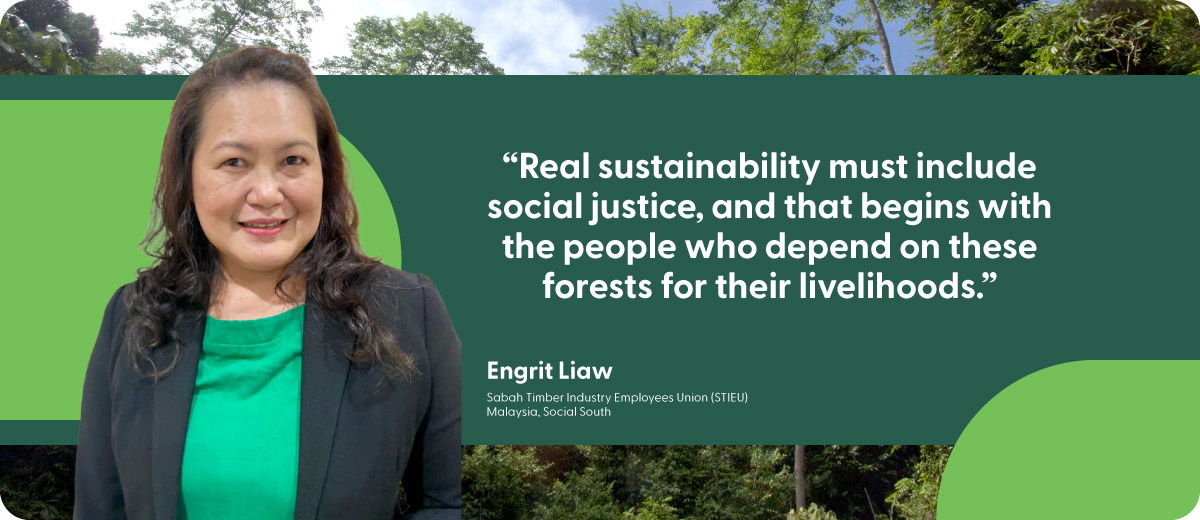
“Real sustainability must include social justice, and that begins with the people who depend on these forests for their livelihoods.”
Can you share a moment when you saw FSC's impact firsthand—economically, socially or environmentally?
A giant company in Sabah, Malaysia, practised union busting. The company has obtained logging certificates in stages, however, denying the rights of unionised workers, and at the same time, employment issues such as safety and basic rights are not fixed. The company continues to oppose the rights of workers to join a trade union, even though the union has won several times in civil court and continues to thwart but was eager to get full FSC certification. STIEU, together with BWI, filed a complaint to the FSC dispute resolution committee, and some benefits and safety issues were fixed. However, since the company still refused to respect ILO C87 and C98, STIEU had no choice but to file against the company for their compliance with the Policy for Association (PfA).
I also have some good and bad experiences. However, the similarity in the tripartite settlement consultation gives confidence in FSC certification.
What is one change or improvement you hope to drive through your FSC membership going forward?
As a trade unionist in Malaysia, particularly in East Malaysia (Sabah), I hope to see the strengthening and enforcement of FSC's Core Labour Requirement at the ground level, especially freedom of association and fair treatment of workers in certified forestry operations.
I aim to push for stronger monitoring mechanisms, transparency in audit processes, and the inclusion of direct worker consultations through union representation.
I hope to ensure that FSC certification in Malaysia is not just a symbol of sustainability but a guarantee that workers in the forest sector are treated fairly, have the right to organise and are protected from exploitation. It also becomes a tool for advancing human rights, workplace dignity, and stronger labour institutions. Real sustainability must include social justice, and that begins with the people who depend on these forests for their livelihoods.
How has FSC membership enabled you to make a difference in your field or community? Can you give an example?
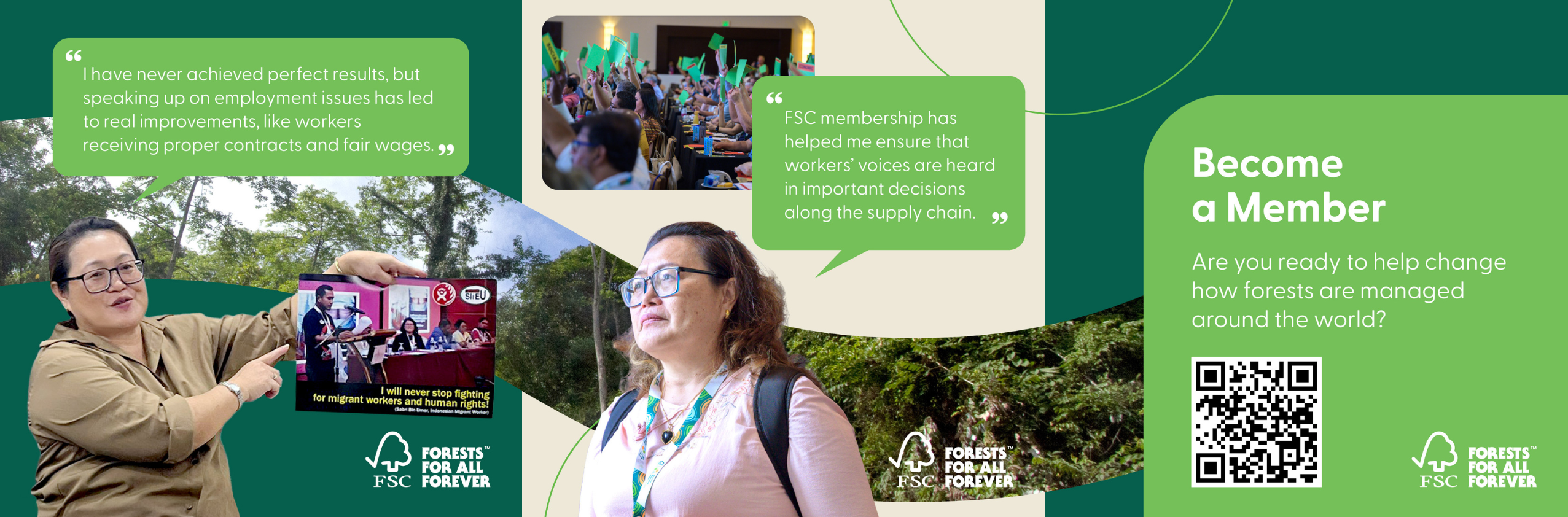
FSC membership has helped me bring workers' voices into important decisions along the supply chains. For example, I was able to raise concerns about the treatment of migrant workers at a certified company in Sabah. Because of this, the company improved conditions like better rest time, fair pay and safety in the workplace. Being part of FSC gave me a way to make real changes that protect both people and forests. The FSC platform would help to push for those changes within a formal, accountable system. It showed that FSC membership is not just symbolic, it can be a real lever for social change when we use it strategically and persistently.
In your sector, what unique challenges does FSC help address, and how have you seen progress?
In Malaysia one big challenge is protecting the rights of migrant and contract workers, who often face poor working conditions and have little voice. FSC helps address this by setting clear standards for fair treatment, safety, and workers' rights.
I have experienced progress where FSC-certified companies started improving workers basic rights, providing PPE, and fair pay. Although it is not perfect yet, FSC is helping move things in the right direction.
Looking back, what accomplishment as an FSC member are you most proud of, and what made it possible?
I have never achieved perfect or best results, but I am proud to be able to voice employment issues and see changes in the direction of improvement like receiving proper contracts, fair wages etc. However, one day when there is a deep awareness achieved, it is not impossible to see the success of FSC certification.
What made it possible was being part of FSC's Social Chamber, where I could raise these concerns formally and work with other members or chambers to push for change. When we use FSC's system holistically together, we can protect workers' rights.
Engrit’s experience shows how FSC can be used to confront abuse, lift standards, and make workers’ rights part of forest certification, not an afterthought. When workers are visible and heard, responsible forestry becomes real in the places where forest work shapes people’s lives.
Learn how to become an FSC Member here.